
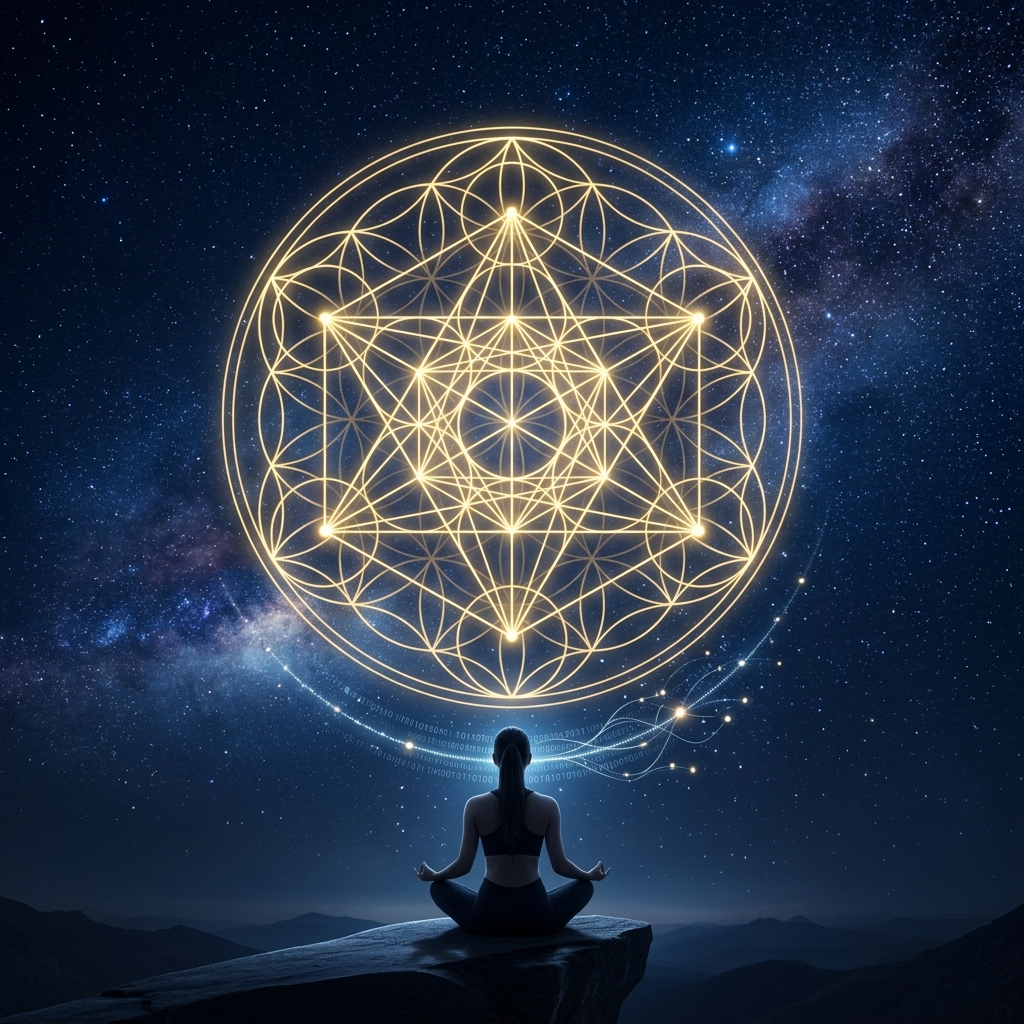
Look closely enough at the structure of a nautilus shell, the arrangement of seeds in a sunflower, the proportions of the human body, the layout of ancient temples, and the molecular structure of DNA, and you will find the same mathematical relationships appearing again and again. The Golden Ratio. The Fibonacci sequence. Hexagonal symmetry. Spirals of specific proportional relationships. These are not coincidences, and they are not the projection of a pattern-seeking mind onto random data. They are genuine structural features of reality — the mathematical language through which creation organizes itself across every scale of existence.
Quick Summary: Sacred geometry is the study of the geometric forms and mathematical relationships that appear consistently throughout nature, art, and architecture — and their symbolic significance as expressions of the organizing principles of creation. Key forms include the Flower of Life, the Fibonacci spiral, the Platonic Solids, Metatron's Cube, and the Vesica Piscis. Harry B Joseph's Book of Symbolism provides one of the most accessible and comprehensive modern guides to understanding and applying these principles.
📐 Study Sacred Geometry with the Book of Symbolism
Harry B Joseph's Book of Symbolism provides the definitive modern guide to sacred geometry and symbolic literacy.
Shop the Full Collection →| Sacred Form | Mathematical Basis | Appears In | Spiritual Meaning | Practical Application |
|---|---|---|---|---|
| Flower of Life | Overlapping circles at specific intervals | Egyptian temples, da Vinci notebooks | Template of all creation | Meditation focal point, intention-setting |
| Fibonacci Spiral | Each number is sum of preceding two | Shells, galaxies, flowers, leaves | Life force growth pattern | Art, architecture, financial trading |
| Golden Ratio (Phi) | 1:1.618… irrational number | Human body, art, nature, DNA | Divine proportion, aesthetic harmony | Design, healing arts, proportion study |
| Platonic Solids | 5 perfectly regular 3D polyhedra | Molecular structures, crystals | Building blocks of the elements | Crystal healing, elemental meditation |
| Metatron's Cube | 13 circles from Fruit of Life | Kabbalistic tradition | Contains all Platonic Solids | Protection, transformation work |
What Is Sacred Geometry? The Foundation
Sacred geometry is the study of geometric patterns, forms, and mathematical relationships that appear consistently throughout the natural world, in the architecture of ancient sacred sites, and in the symbolic traditions of every major civilization — and the exploration of what these patterns reveal about the organizational principles of reality itself.
The "sacred" dimension of sacred geometry does not imply that these forms are exclusively religious. Rather, it indicates that these particular geometric relationships encode principles of such fundamental importance — the principles by which creation itself organizes — that they have been consistently treated with reverence across cultures and millennia. The same patterns found in the geometric proportions of the Parthenon appear in the design of Chartres Cathedral, the layout of Angkor Wat, and the proportions of the Great Pyramid. The same mathematical relationship (the Golden Ratio) that governs the arrangement of seeds in a sunflower also governs the proportions of the human face, the structure of DNA, and the spacing of orbital periods in the solar system.
According to research published in Nature Scientific Reports, the Fibonacci sequence and associated Golden Ratio appear in plant phyllotaxis (leaf and seed arrangement) with remarkable mathematical precision — not as an approximation but as an exact expression of the optimal packing solution derived from the mathematical properties of the Phi ratio. This is not imposed by human culture on nature; it is the natural world demonstrating the operation of mathematical principles that sacred geometry has studied for millennia.
Harry B Joseph's Book of Symbolism treats sacred geometry as one of the most direct windows into the organizational intelligence of reality. Understanding these forms — their mathematical basis, their appearance in the natural and human-made world, and their symbolic significance — is a fundamental component of the symbolic literacy that the Book of Wisdom's framework seeks to develop.
Best for: Seekers who want to understand the mathematical dimension of spiritual reality and develop a genuine relationship with the geometric language of creation.
The Flower of Life: The Template of Creation
The Flower of Life is a geometric pattern consisting of multiple overlapping circles arranged in a specific hexagonal grid, generating a flower-like pattern of extraordinary visual symmetry. It is found carved into stone at the Temple of Osiris at Abydos (Egypt), in the Forbidden City of Beijing, at Ephesus in Turkey, and in numerous other ancient sacred sites across multiple independent civilizations — a convergence that strongly suggests these cultures recognized a genuine significance in this pattern rather than independently inventing a pleasing design.
Within the tradition of sacred geometry, the Flower of Life is understood as a visual encoding of the mathematical relationships from which all other sacred geometric forms can be derived. The Vesica Piscis (the lens shape formed by the intersection of two circles of equal radius whose centers are on each other's circumference) emerges directly from the first step of constructing the Flower of Life. The Fruit of Life (a pattern of 13 circles extracted from the Flower of Life) contains the mathematical information from which Metatron's Cube is constructed, and Metatron's Cube in turn contains all five Platonic Solids — the fundamental three-dimensional forms that ancient Greek philosophy identified as the building blocks of physical reality.
In contemplative practice, the Flower of Life serves as a powerful meditation focal point. Its visual complexity and inherent harmony naturally settle the discursive mind, while its encoded mathematical relationships work on the subtler levels of perception and consciousness in ways that practitioners report as deeply harmonizing and centering.
Best for: Seekers exploring the contemplative and meditative dimensions of sacred geometry alongside its intellectual and historical aspects.
The Golden Ratio and Fibonacci Sequence: Nature's Design Language
The Golden Ratio — designated by the Greek letter Phi (Φ) and equal to approximately 1.618 — is an irrational number with extraordinary properties. It is the only number whose reciprocal (1/Φ) and square (Φ²) are related to it by simple addition and subtraction: 1/Φ = Φ - 1, and Φ² = Φ + 1. This self-referential mathematical property makes it uniquely stable — a fixed point in the infinite process of proportion that generates forms of inherent harmonic coherence.
The Golden Ratio appears throughout the natural world with remarkable consistency. The ratio of consecutive Fibonacci numbers (1, 1, 2, 3, 5, 8, 13, 21, 34, 55...) converges toward Phi with increasing precision as the sequence progresses. Sunflower seeds are arranged in intersecting spirals whose counts are always consecutive Fibonacci numbers. The human arm is divided at the elbow in approximately the Golden Ratio. The DNA double helix measures 34 Angstroms in length per full cycle and 21 Angstroms in width — consecutive Fibonacci numbers.
The Fibonacci sequence itself — in which each number is the sum of the two preceding numbers — generates a spiral growth pattern that appears wherever living systems are growing from a central point: in nautilus shells, in galaxies, in the arrangement of branches on trees, in the curl of a wave. This is the mathematical expression of the life force's characteristic pattern of growth — a pattern that the Book of Symbolism identifies as one of the most fundamental signatures of creative intelligence in the physical world.
Artists and architects from ancient Egypt to Leonardo da Vinci to the Bauhaus movement have deliberately employed the Golden Ratio in their work, finding that proportions based on Phi produce an innate sense of harmony and beauty in viewers — a response that crosses cultural boundaries because it reflects not learned aesthetic preference but the deep recognition of a proportion that is genuinely fundamental to the human perceptual system.
🌟 Ready to Go Deeper?
Explore Harry B Joseph's complete product line — books, symbolism tools, wisdom cards, and spiritual study guides through Revival of Wisdom.
View All Products →The Platonic Solids: Building Blocks of Reality
The Platonic Solids are the five perfectly regular three-dimensional forms — shapes in which every face is identical, every edge is the same length, and every interior angle is identical. There are exactly five such solids, a mathematical constraint that Plato found deeply significant: the tetrahedron (4 triangular faces), the cube (6 square faces), the octahedron (8 triangular faces), the dodecahedron (12 pentagonal faces), and the icosahedron (20 triangular faces).
Plato associated each of these five solids with one of the five classical elements: the tetrahedron with fire (its sharp points and minimal surface-to-volume ratio suggesting the penetrating quality of heat), the cube with earth (its stability and rectangular symmetry reflecting the solidity of matter), the octahedron with air, the icosahedron with water, and the dodecahedron — which Plato called the "fifth element" — with the cosmos itself, the organizing form of the universe.
Modern science has found the Platonic Solids embedded in molecular geometry (the tetrahedron in methane, the octahedron in sulfur hexafluoride), in the structure of viruses (the icosahedral capsid symmetry found in hundreds of viral species), and in the atomic arrangement of crystals. Their appearance in both ancient cosmological philosophy and contemporary molecular science reflects the same recognition: these are not arbitrary forms but fundamental solutions to the mathematical problem of symmetric spatial organization.
How to Use Sacred Geometry in Daily Practice
Sacred geometry is not only a subject of intellectual study but a practical tool for meditation, intention-setting, and environmental design. The harmonizing effect of these forms on human perception and consciousness — recognized by ancient tradition and increasingly validated by contemporary research — makes them genuinely useful instruments for the practicing seeker.
The simplest daily practice is meditative contemplation of a sacred geometric form. Choose a form that resonates — the Flower of Life, the Fibonacci spiral, a Sri Yantra, or a simple Vesica Piscis — and spend ten to fifteen minutes allowing your gaze to rest softly on the form while maintaining open awareness. The visual mind settles naturally into the harmonic structure of the pattern, and this settling produces a measurable quieting of discursive mental activity.
Environmental use of sacred geometric proportions — in the arrangement of home spaces, in the design of personal altars or meditation areas, in the selection of geometrically significant objects — works through a subtler channel: the continuous background influence of harmonically proportioned space on the nervous system and energetic field. The Book of Symbolism provides specific guidance on applying sacred geometric principles in physical space for maximum harmonizing effect.
Frequently Asked Questions
What is the Flower of Life and why is it sacred?
The Flower of Life is a geometric pattern of overlapping circles in a hexagonal arrangement, found in ancient sacred sites across multiple civilizations including Egypt, China, Turkey, and India. It is considered "sacred" because it encodes the mathematical relationships from which all other sacred geometric forms can be derived — including the Platonic Solids, the Golden Ratio relationships, and the Fibonacci spiral structure. In contemplative practice, it serves as a powerful meditation focal point whose inherent mathematical harmony produces a naturally settling effect on the mind.
What is the difference between the Golden Ratio and the Fibonacci sequence?
The Fibonacci sequence (1, 1, 2, 3, 5, 8, 13, 21, 34...) is an integer sequence in which each number is the sum of the two preceding numbers. The Golden Ratio (Phi ≈ 1.618) is an irrational number with unique self-referential mathematical properties. The connection between them is that the ratio of consecutive Fibonacci numbers (8/5, 13/8, 21/13, etc.) converges with increasing precision toward the Golden Ratio as the numbers get larger. The Fibonacci sequence is, in a sense, nature's integer approximation of the Golden Ratio — generating the spiral growth patterns seen throughout the living world.
How does sacred geometry relate to spiritual development?
Sacred geometry relates to spiritual development in two primary ways. First, studying these forms develops symbolic literacy — the capacity to perceive the organizing principles of reality through their mathematical and geometric expressions. This shifts perception from the surface level of appearances to the structural level of underlying principles, which is a fundamental step in consciousness development. Second, meditating with sacred geometric forms produces measurable effects on awareness — settling discursive mental activity, expanding perceptual sensitivity, and attuning consciousness to the harmonic frequencies encoded in these universal patterns.
Is sacred geometry connected to the Book of Wisdom?
Yes. Harry B Joseph's Book of Symbolism — the companion volume to the Book of Wisdom — includes comprehensive coverage of sacred geometry as one of the primary vocabularies of the symbolic language of reality. Students of the Book of Wisdom learn sacred geometry as part of their broader symbolic literacy training, understanding it not as a separate esoteric subject but as one dimension of the unified symbolic framework through which the Book of Wisdom approaches the decoding of reality's hidden language.
📚 Continue Your Wisdom Path
The Harry B Joseph Book of Wisdom ecosystem offers physical books, symbolism study materials, wisdom oracle cards, and community access through Revival of Wisdom.
Shop the Full Collection →Ready to Go Deeper?
Explore the complete Harry B Joseph product line — books, symbolism tools, wisdom cards, and spiritual study guides.
View All Products →